
Speaking of work clothes, everyone’s first impression is definitely work clothes, and the fabrics are nothing more than gauze and Oxford cloth. However, workwear has undergone tremendous changes nowadays. The rapid changes in fabrics have given workwear continuous upgrades. When workwear meets functional fabrics, the original ordinary workwear is immediately transformed and becomes the “Armani” of the workwear world. So what are the powerful performances of functional workwear now? Let us unveil its mystery from the following fabrics.
White Oxford cloth – Recommendation index ★★★★★
Maybe when you see the subtitle, you will think to yourself, who doesn’t know how to make Oxford cloth coated with white? There are a lot of them on the market. The author wants to say, yes. Anyone who makes regular Oxford cloth can do it. Since the author recommends it, it must be full of gold content. I generally won’t mention the mass-market products. So what’s so special about this white-coated Oxford cloth?
SGS certified polycyclic aromatic hydrocarbons <0.1mg/kg
As we all know, polycyclic aromatic hydrocarbons are highly polluting substances. Fabrics often inevitably contain such substances after dyeing, coating and finishing. If they are exposed to high concentrations of polycyclic aromatic hydrocarbons for a long time, they will cause Diseases and even cancer. There are clear limit requirements for this substance in SGS certification, which are mainly divided into three categories:
Category 1: Materials that may be placed in the mouth. BaP shall not be detected (less than 0.2mg/kg), and the sum of 16 items shall not be detected (less than 0.2mg/kg)
Category 2: Materials that may come into long-term contact with skin (contact time exceeds 30 seconds). BaP must not be detected (less than 1mg/kg), and the sum of 16 items must not be detected (less than 10mg/kg)
Category 3: Materials that may come into long-term contact with the skin (contact time does not exceed 30 seconds) or materials that may not come into contact. BaP shall not be detected (less than 20mg/kg), and the sum of 16 items shall not be detected (less than 200mg/kg).
For fabrics such as workwear, as long as the second item of BaP is not detectable (less than 1mg/kg) and the total of 16 items is not detectable (less than 10mg/kg), it can be recognized by the European and American markets and get a pass to enter the European and American markets. . However, the white-coated Oxford cloth recommended today can be said to have achieved the ultimate in epoxy aromatic hydrocarbon standards, and the fabric has reached food-grade standards, perfectly embodying the spirit of craftsmanship.
The washing fastness of fluorescent products is much higher than the EU standard
Many Oxford fabrics for workwear are in fluorescent colors, among which fluorescent yellow, fluorescent red, and fluorescent orange are relatively common colors. For fluorescent fabrics, there are independent testing standards in the industry, among which EN ISO 20471 is the EU standard.
From October 1, 2013, the European Commission decided that EN ISO 20471:2013 “High Visibility Clothing – Test Methods and Requirements” will become the new harmonized standard for safety reflective clothing in the EU. The EN20471 standard is an upgraded version of the EN471 standard. The fluorescence detection is required to be carried out after washing with water 5 times. The color fastness to discoloration reaches level 4 or above, the color fastness to staining reaches level 4 or above, the breaking strength is ≥400N, and the tearing strength is ≥20N.
Fluorescent fabrics will pass if they meet the EN20471 requirements for fastness after being washed 5 times. However, after being washed 25 times, the Oxford fabric here can safely pass the EN 20471 fluorescent standard in terms of color fastness, tear fastness and other indicators. Real gold is not afraid of fire. High-quality raw materials create top-quality fabrics, ensuring the high performance of the fabrics from the inside out. Such fabrics are produced in the Shengze market. Do you think the author would strongly recommend it?
Three-in-one fabric – Recommendation index ★★★★★
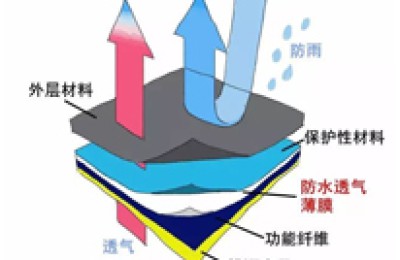
Three-in-one fabrics can be said to be classic products among functional fabrics. Introducing three-in-one fabrics into workwear can also be said to be an extension of a product. Three-in-one fabric combines three different materials through composite processing to become a comprehensive fabric with multiple functions. Plaid taslan + TPU + polar fleece, four-way stretch pongee + transfer film + polar fleece are all evergreen trees for functional workwear fabrics. Three-in-one fabrics often have moisture-wicking, breathable and moisture-permeable functions. However, the three-in-one fabric here is not limited to these functions. Its magic weapon is that it does not degumming or foaming after 25 times of washing. Fabrics are durable and stable quality can be recognized by customers.
In addition, level 4 color fastness is generally the top standard in the industry. The color fastness of the composite fabric here can reach level 4-5, which completely beats the high standard color fastness of level 4. It is reported that these fabrics are made into clothing after contrasting colors, such as navy blue with yellow. If the color fastness is not up to standard, summer clothing is packed in containers and the shipping time often takes a month. Under the influence of long-term high temperature Color migration is very easy to occur in clothing. If there is a color match in the clothing, the entire batch of goods will become defective. This requires the fabric to pass the most stringent color fastness test, and not only the test sample must pass, but the quality of the entire batch must be as high as the sample and must undergo the test of the real environment.
Having said all this, which company can produce such high-standard fabrics? The author is not trying to sell anything here. Wujiang Chunzhu Textile is a company specializing in the production of these fabrics. According to Mr. Wang of Chunzhu Textile, they produce functional fabrics.They have been engaged in clothing fabrics for more than 10 years, and have been working hard in the workwear fabric industry for so many years, which made them realize that only high-quality guarantee can gain the trust of customers. In fact, every fabric they produce has the indicators of high color fastness and low harmful substances described by the author above. At the same time, as a functional fabric, how can it lack indicators such as UV resistance, moisture wicking, and flame retardancy? Mr. Wang said that functional fabrics are still being continuously upgraded and developed, and there is still a lot of room for development of functional workwear fabrics. Chunzhu Textile will not stop on the road of functional workwear. As the saying goes, there is no end to learning, and the same is true for making fabrics. Only by making progress can we make greater progress.
</p