
Let’s first understand the shaping mechanism of the fiber
At the glass transition temperature, the atoms or atomic groups in the macromolecular chain in the amorphous region of the fiber can only occur at the equilibrium position. Vibration, intermolecular forces will not be broken up, and chain segments cannot move. When the temperature is higher than the glass transition temperature, the thermal motion of the molecular chain segments intensifies and the intermolecular force is destroyed. At this time, if a certain tension is applied to the fiber, the molecular chain segments can wriggle and rearrange according to the direction of the external force. The intermolecular force is re-established between adjacent molecular chains at a new position. After cooling, this new equilibrium state is fixed, which causes the fiber to have a shaping effect under this temperature condition.
How to pair 210D How about shaping and finishing Oxford cloth?
The process of 210D Oxford cloth undergoing certain processing to obtain the required shape and maintain its stability is called styling finishing. Oxford cloth heat setting can be divided into dry heat setting and wet heat setting.
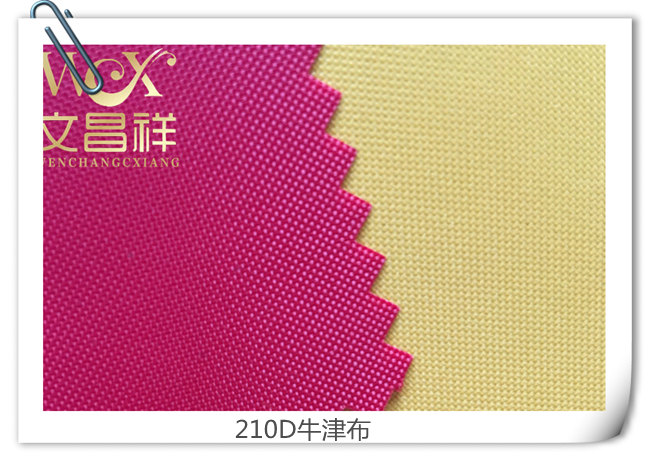
Heat setting The temperature is actually between the glass transition temperature (Tg) and the melting point temperature (Tm) of the fiber. Although the heat setting temperature is lower than the melting point of the fiber, it can still change the crystallization zone, grains and crystals in the fiber molecules. .
Dry heat setting is a heat setting process that heat-treats 210D Oxford cloth in a dry, water-free state. Since water has little puffing effect on polyester, conventional polyester and its blended fabrics mostly use dry heat setting process. The setting temperature is higher than that of wet heat setting method, generally between 180-210°C.
To learn more about Wen 210D Oxford cloth, please consult textile customer service or call the hotline: 400-8380917.
</p